
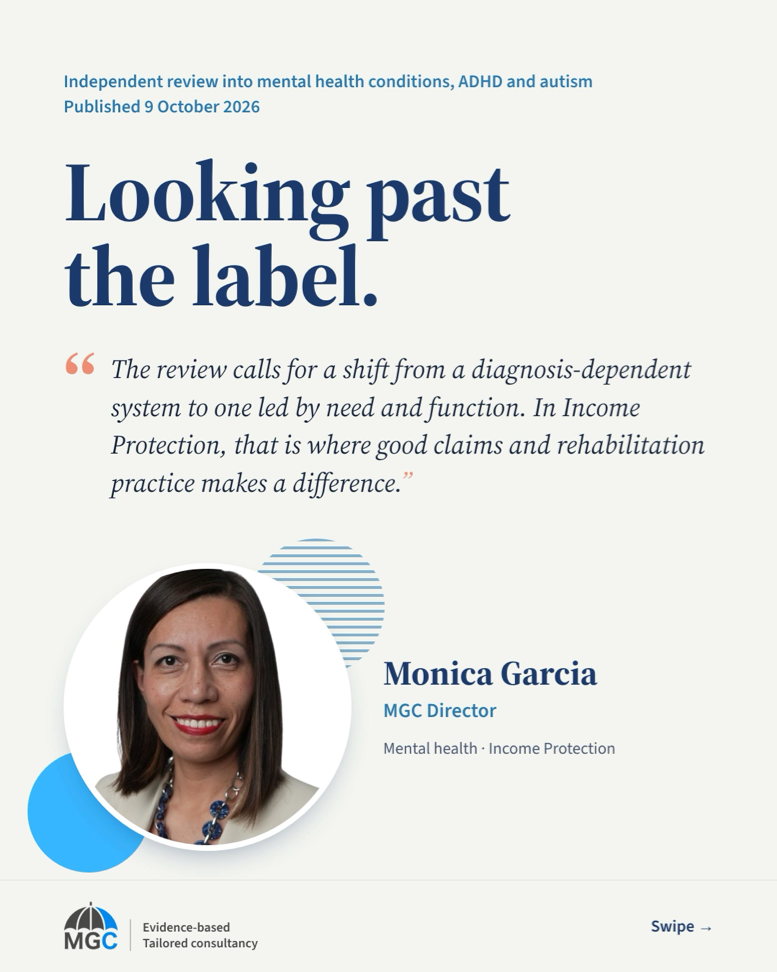
Looking past the label: What the independent review into mental health, ADHD and autism means for Income Protection
The Department of Health and Social Care published its independent review into mental health conditions, ADHD and autism, led by Professor Peter Fonagy (09/10/2026). Its central argument is one I strongly agree with: support should be led by a person's needs and by how they are actually functioning, not held back until a diagnosis arrives.
What the review is asking for
The review describes a shift from a "diagnosis-dependent" system to a "needs-led plus diagnosis" system. There were 3 interesting themes:
The early intervention window
The review cites CQC evidence that around 1 in 4 people whose wait for support is under two weeks see their difficulties get worse. For those waiting longer than six months, it is more than 7 in 10.
In Income Protection this mirrors deferred periods. The earlier we understand how someone is coping, and what their needs are, the more we can do. Support does not need to wait for a label.
None of this is simple
The review is honest about the complexity. Underdiagnosis, misdiagnosis and overdiagnosis can all happen in the same system at the same time. There is no biological test. Traits sit on a continuum, and functional impairment is still inconsistently defined and recorded.
As Professor Sir Simon Wessely, vice-chair of the review, put it, a diagnosis "can close doors just as much as it opens doors". When a label becomes someone's identity, it can quietly limit what they believe they can return to.
In Income Protection, we start with function
A diagnosis tells us what the condition is. Function tells us what it means for this person, in their role. We look at the whole person, e.g. concentration, energy, sleep, confidence and routine, and set that against the demands of their occupation. With mental health, presentations can vary significantly, so this matters most of all.
Everyone is different
Two people with the same diagnosis can have very different support needs. How about we ask: what does this person need to take part in work again?
If you would like to talk through how a needs-led, function-first approach applies to your own claims book, you can find me at mgcuk.co.
Monica Garcia, Director, MGC
Download the six-page summary (PDF)