Early intervention in Income Protection: 5 tips for insurers
Intro
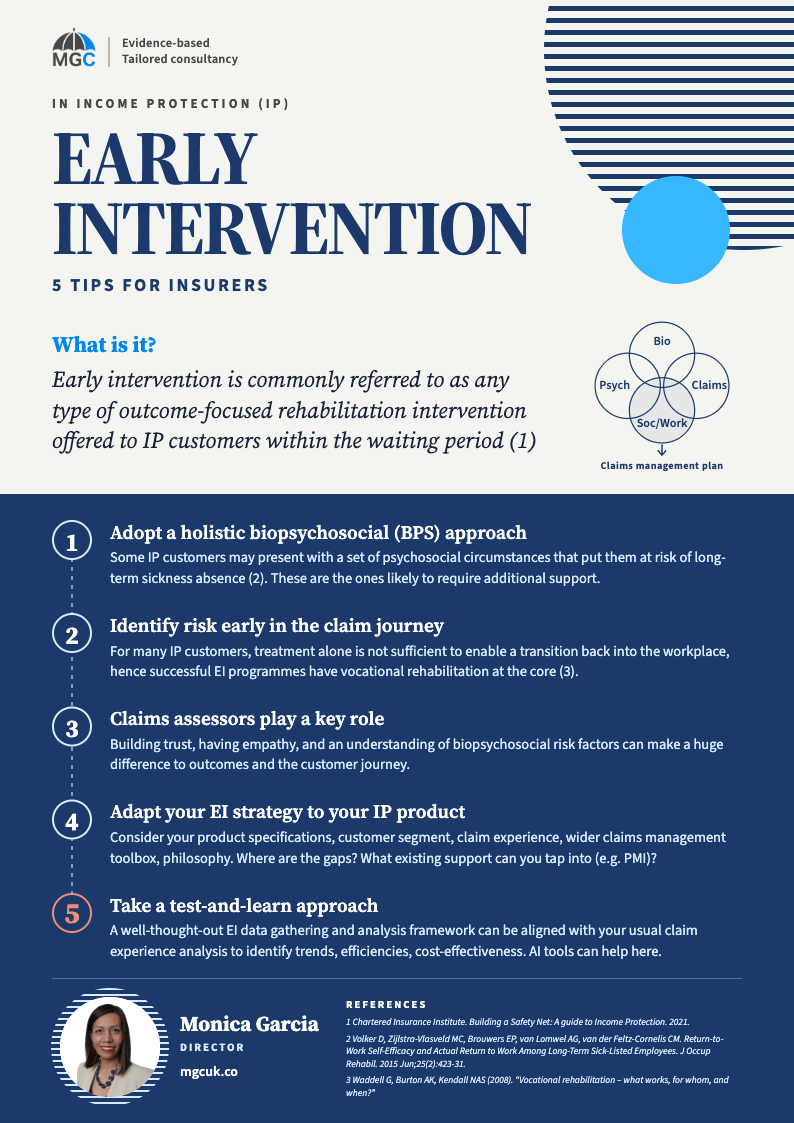
Early intervention (EI) is commonly referred to as any type of outcome-focused rehabilitation intervention offered to Income Protection customers within the waiting period (1). Done well, it supports customers back to wellness and back to work, and improves the claims experience for everyone involved. Here are five things I would encourage any IP insurer to consider.
1. Adopt a holistic biopsychosocial (BPS) approach
Some IP customers may present with a set of psychosocial circumstances that put them at risk of long-term sickness absence (2). These are the ones likely to require additional support. Looking at the person as a whole, their health, their thinking, their work and their social situation, gives a far better picture than the diagnosis alone.
2. Identify risk early in the claim journey
For many IP customers, treatment alone is not sufficient to enable a transition back into the workplace. That is why successful EI programmes have vocational rehabilitation at their core (3). The earlier risk is identified, the earlier the right support can begin.
3. Claims assessors play a key role
Building trust, having empathy, and an understanding of biopsychosocial risk factors can make a huge difference to outcomes and the customer journey. The assessor is pivotal. The first interaction with the customer sets the tone for everything that follows.
4. Adapt your EI strategy to your IP product
Consider your product specifications, customer segment, claim experience, wider claims management toolbox and claims philosophy. Where are the gaps? What existing support can you tap into, such as private medical insurance? There is no single, blanket EI model that fits every book of business.
5. Take a test-and-learn approach
A well-thought-out EI data gathering and analysis framework can be aligned with your usual claim experience analysis to identify trends, efficiencies and cost-effectiveness. AI tools can help here, provided the questions you are asking are the right ones.
Closing
Early intervention works best when it is built around the person and the product. If you would like to talk through how these principles apply to your own claims book, drop me a line.
Monica Garcia, Director, MGC
References